






A Contractor’s Guide to Bookkeeping for Construction Industry
Posted Date: Feb 9th, 2026 at 07:06 AM
Location: Melbourne VIC 3000, Australia
Price: $0.00
Construction businesses often face financial issues not because of poor workmanship but because of poorly managed books. When financial records are unclear, contractors make decisions based on assumptions instead of facts. This is why bookkeeping for construction industry plays a critical role in maintaining stability and growth.
Unlike many other businesses, construction projects are always changing. Costs shift frequently, payments come in stages, and multiple projects run at the same time. A simple income-and-expense system is not enough. Proper bookkeeping must track each project, each cost, and each payment carefully from start to finish.
Without structured bookkeeping, even busy contractors may struggle with cash flow, unclear profits, and rising expenses. Having a proper system in place brings clarity and helps businesses grow with confidence.
Why Construction Businesses Need Specialized Bookkeeping
Construction bookkeeping is different from standard bookkeeping because every project has unique costs, timelines, and payment structures. Each job requires detailed tracking to ensure profitability and smooth operations.
Some key reasons construction businesses need specialized bookkeeping include:
Projects are job-based, not routine sales
Costs must be tracked per project
Payments are often delayed or milestone-based
Retainage affects cash flow
Change orders frequently adjust costs and revenue
A general bookkeeper may record transactions, but a construction-focused bookkeeper understands how projects operate financially. Without proper bookkeeping for construction industry, contractors may face cash shortages, incorrect billing, and hidden losses.
Why Construction Bookkeeping Is More Complex
Job Costing vs Regular Accounting
In construction, profit must be tracked for each project rather than only for the overall business. Job costing helps monitor labor, materials, subcontractors, and equipment expenses for every project.
Without job costing:
Project profits remain unclear
Losses go unnoticed
Future bids may be inaccurate
Accurate job costing is the foundation of strong bookkeeping in construction.
Managing Multiple Projects and Payments
Contractors often handle several projects at once, each with different timelines and billing cycles. Bookkeeping must track progress billing, partial payments, and outstanding invoices.
Proper tracking ensures that income and expenses are matched to the right project, giving a clear view of cash flow and profitability.
Tracking Change Orders and Retainage
Change orders are common in construction and affect both project costs and revenue. If not tracked properly, contractors may lose income.
Retainage is another challenge. A portion of payment is often held until project completion. Bookkeeping for construction industry ensures retainage amounts and release schedules are tracked accurately so cash flow remains stable.
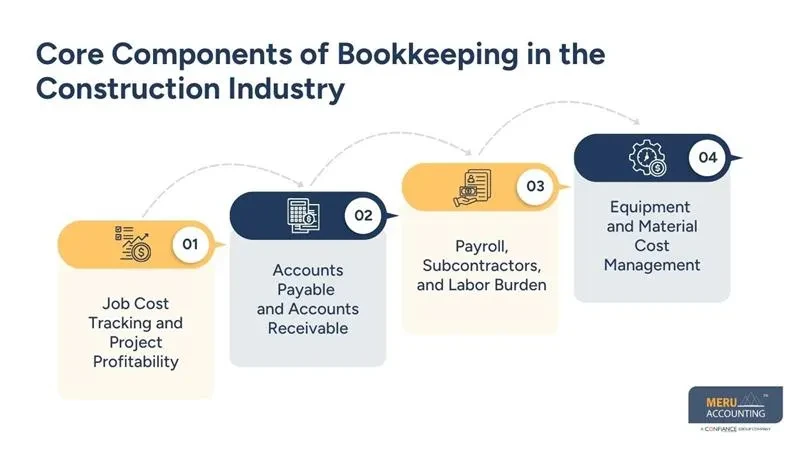
Core Areas of Construction Bookkeeping
Job Cost Tracking and Project Profitability
Tracking costs for each project helps contractors understand where money is being spent and how profitable each job is. This includes monitoring:
Budget vs actual expenses
Labor and subcontractor costs
Materials and equipment usage
Profit margins per project
Regular review of these numbers helps identify issues early and keep projects on track.
Accounts Payable and Receivable
Managing incoming and outgoing payments is essential. Bookkeeping ensures:
Supplier and subcontractor bills are paid on time
Invoices are issued correctly
Overdue payments are followed up
Cash flow remains stable
This prevents delays and financial stress during projects.
Payroll and Subcontractor Tracking
Labor is one of the largest expenses in construction. Proper bookkeeping tracks wages, overtime, taxes, and subcontractor payments. It also ensures labor costs are allocated to the correct project, giving an accurate picture of job profitability.
Equipment and Material Costs
Equipment and materials represent major investments. Bookkeeping tracks equipment usage, maintenance, and depreciation. Material costs must also be monitored regularly to avoid overspending and budget issues.
Accurate tracking helps control costs and improve long-term planning.
Additional Details
| Business Type Supported | Meru Accounting |
