






How Construction Accounting Helps Avoid Cash Flow Gaps Between Projects
Posted Date: Feb 3rd, 2026 at 07:02 AM
Location: New York, NY 10004, USA
Price: $0.00
Construction accounting is essential for keeping construction businesses financially stable—especially when projects start and end at different times. Many contractors face cash flow problems not because they lack work, but because payments don’t arrive when expenses must be paid. Payroll continues, vendors need payment, and overhead costs never stop. Without proper tracking, cash gaps can grow quietly and create serious stress.
Unlike general bookkeeping, construction accounting focuses on project-based income and expenses. It helps contractors monitor costs, manage billing, and plan cash movement between projects. When done correctly, it reduces cash shortages and keeps businesses ready for upcoming jobs.
This blog explains how construction accounting helps prevent cash flow gaps between projects and why using the right accounting approach supports long-term success.
What You Will Learn From This Blog
In this blog, you will learn:
- What construction accounting is and how it differs from general accounting
- Why cash flow gaps happen between construction projects
- How project-based tracking supports steady cash flow
- Which accounting methods help control project finances
- How billing, retention, and unpaid invoices affect cash flow
- How overhead costs are managed across projects
- Why work-in-progress (WIP) reports matter
- Common cash flow mistakes contractors make
What Is Construction Accounting and How Is It Different From General Accounting?
Construction accounting is designed for businesses that work job-by-job. Each project has its own timeline, costs, and payment schedule, so finances must be tracked per project.
General accounting usually tracks business income and expenses monthly. Construction accounting, however, tracks costs and revenue at the job level so contractors can see which projects are profitable and where money is being spent.
Quick Comparison
- Construction accounting: project-based tracking, progress billing, changing cash flow
- General accounting: company-wide tracking, regular monthly income patterns
Because construction cash flow depends on project timelines, specialized methods are needed.
Why Cash Flow Gaps Happen Between Projects
Cash flow gaps are common in construction due to:
Delayed client payments
Invoices often depend on approvals, which can take weeks.
Retention holdbacks
A portion of payment is kept until the project is complete, reducing cash during the job.
High upfront costs
Materials, labor, and equipment are paid before payments come in.
Weak project cost tracking
Without construction accounting, contractors may not know true job costs.
Gaps between billing cycles
When one project ends and the next has not started billing, income drops suddenly.
Lack of cash planning
Profit may look fine, but timing issues still create shortages.
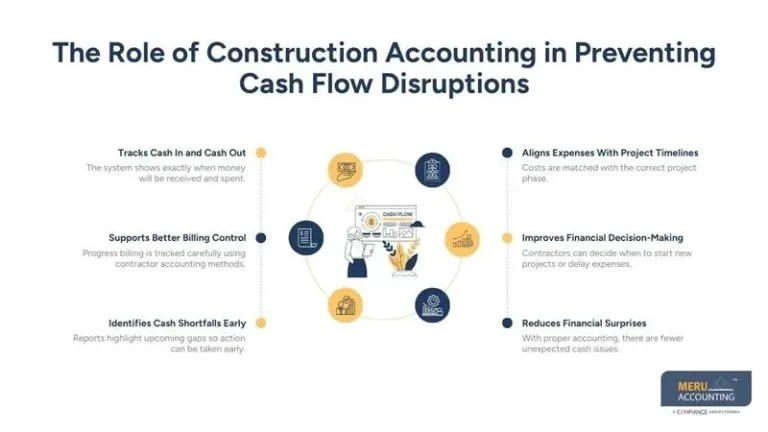
How Construction Accounting Prevents Cash Flow Disruptions
A good construction accounting system helps contractors stay prepared by:
- tracking cash coming in and going out
- keeping billing organized and on schedule
- spotting cash shortfalls early
- matching costs with the correct project stage
- reducing unexpected financial surprises
- supporting smarter decisions on when to start new jobs
How Construction Accounting Improves Project Cash Planning
Project-based planning is a major benefit of construction accounting, including:
- job-specific budgets
- phase-wise cost control
- forecasting future cash needs
- planning payroll and labor costs
- scheduling vendor payments
- ensuring smoother transitions between projects
This planning reduces the risk of running short on cash when projects overlap or slow down.
Construction Accounting Methods That Support Better Cash Flow
Different methods help contractors manage project income timing, such as:
- Percentage of completion: income recorded as work progresses
- Completed contract: income recorded after project completion
- Job costing: tracks labor, materials, and overhead by project
- Cash basis: records income when cash is received
- Accrual basis: records income/expenses when they occur
Choosing the right method improves financial control and reduces cash gaps.
How Construction Accounting Manages Billing, Retention, and Receivables
Billing directly affects cash flow. Construction accounting helps by:
- tracking progress billing accurately
- monitoring retention amounts separately
- identifying overdue invoices using receivable reports
- supporting faster dispute resolution
- improving payment follow-ups
- keeping revenue reporting accurate
Managing Overhead Costs Between Projects
Overheads continue even when a project slows down. Construction accounting helps plan and allocate:
- rent and office expenses
- insurance and licenses
- equipment rentals and repairs
- admin salaries
- shared costs across active projects
- cash reserves for stability
This prevents overhead from draining cash unexpectedly.
Why Work-in-Progress (WIP) Reports Matter
WIP reports are a key part of construction accounting. They show:
- value of work completed
- amount billed
- unbilled revenue
- cost overruns
These reports help contractors avoid underbilling, improve planning, and catch project problems early.
Common Cash Flow Mistakes Contractors Make
Without proper construction accounting, contractors often:
- assume more cash is available than reality
- ignore retention impact
- bill late or inconsistently
- fail to track costs per project
- mix business and personal spending
- review reports too late to act
How Meru Accounting Helps Construction Businesses Manage Cash Flow
Meru Accounting provides construction accounting services for contractors, builders, and developers. We help improve cash flow and project profitability through:
- job costing and project tracking
- progress billing and retention monitoring
- cash flow forecasting
- WIP reporting
- overhead allocation across projects
- software support and clear reporting
With Meru Accounting, construction businesses gain stronger control over cash between projects and better financial confidence.
Key Takeaways
- Construction accounting helps prevent cash flow gaps between projects
- Project-level tracking improves cost control and planning
- Billing, retention, and receivables strongly impact cash flow
- WIP reports provide clear insight into project performance
- Professional accounting support improves long-term stability
