


 All Regions
 Australia
 Bermuda
 Brazil
 Canada
 France
 Italy
Italy
 Mexico
 United Kingdom
 United States

ATO Relays Relays Supplier
Posted Date: Jun 15th, 2026 at 09:20 AM
Location: 123 Main St, Parksville, NY 12768美国
Price: $0.00
When a production line goes down, nobody cares about a part's price tag; they care about how fast it can be fixed. At ATO, we are the technical partner B2B buyers lean on when downtime isn't an option. Backed by over 15 years of experience, our modern production base manufactures more than 30 relay series and thousands of standard models directly from our factory. We build the heavy-duty hardware muscle that translates fragile PLC logic into raw electrical power, keeping your operational costs down and your machinery moving.
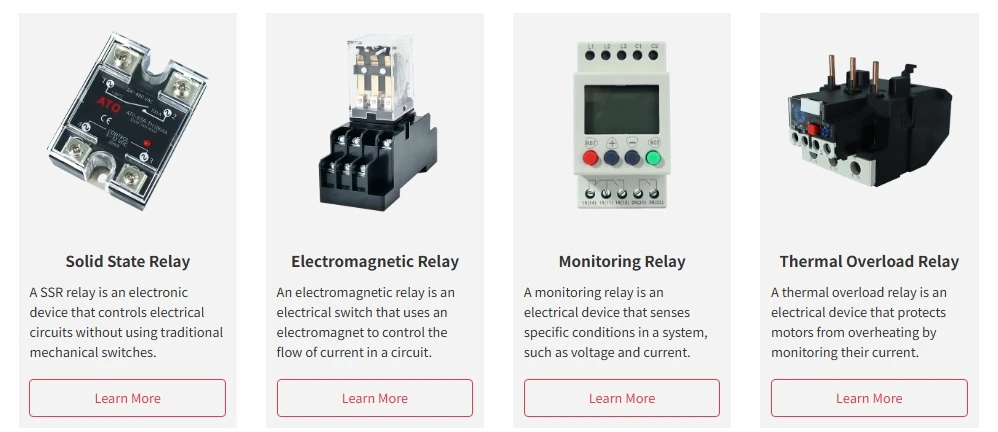
If mechanical wear is killing your uptime, moving to a solid state relay is a total game-changer. By ditching moving parts for microelectronic switching, these units completely wipe out contact bounce and electrical arcing—perfect for high-cycle environments. Conversely, if your setup demands total physical isolation, an electromagnetic relay is still the gold standard, using an electromagnet to safely control current. Our technical support teams can fully customize these electronic relays with specific current, voltage, or power specifications tailored to your exact industrial needs.
But even the toughest setups hit a snag, and a classic field issue is a relay clicking but no output. This is highly deceptive because the audible click tricks you into thinking the relay works when it's actually dead. To fix it, your diagnostic logic must isolate two suspect zones: a control-side voltage drop or load-side contact failure.
First, use a multimeter to check the voltage across the coil terminals while the system is under load. If you have an overloaded power supply or long wire runs, the voltage can tank. When it hovers just below the required pick-up threshold, the magnetic field goes weak. It will have just enough juice to pull the armature—giving you that click—but it lacks the torque needed to firmly compress the contacts. The power line stays completely dead.
If the coil voltage looks great, pivot straight to the contacts. High inrush currents from inductive loads do real physical damage. Over thousands of cycles, electrical arcing creates heavy carbon buildup and deep pitting. This crust acts like an insulator, driving up contact resistance so high that power cannot jump the gap. In the worst cases, the arcing heat actually melts the pads together, causing contact welding that traps your relay permanently stuck.
To permanently get ahead of these headaches, throwing a monitoring relay into your cabinet is a massive win, allowing you to sense voltage and current drops before anomalies wreck your line. Pairing it with a thermal overload relay protects your heavy-duty motors from overheating by constantly monitoring current draw. With millions of units in stock available for same-day delivery, ATO guarantees your project deadlines stay protected. Reach out to our technical team today for a fast quote on our scientifically tested, stable-performance relays.