



Accounting for Construction Companies to Handle Retention and Progress Payments
Posted Date: Feb 10th, 2026 at 06:50 AM
Location: New York, NY 10004, USA
Price: $0.00
Accounting for Construction Companies to Handle Retention and Progress Payments
Construction projects involve many moving parts—materials, labor, subcontractors, timelines, and payments. One of the most challenging areas is managing retention and progress payments. Without proper systems, these payments can affect cash flow, cause disputes, and create financial risk. This is where accounting for construction companies plays a critical role.
Accurate construction accounting helps contractors track payments based on work completed, stay organized, and maintain steady cash flow throughout the project lifecycle.
Understanding Accounting for Construction Companies
Construction accounting is different from standard business accounting. Contractors often work on multiple projects at the same time, each with its own budget, schedule, and payment structure. Accounting for construction companies focuses on tracking costs and income by project, not just overall business totals.
Retention and progress payments are common in construction contracts. If they are not tracked correctly, contractors may face delayed payments or unexpected cash shortages. Clear and accurate accounting helps prevent these issues.
What Are Progress Payments and Retention?
Progress payments are partial payments made as work is completed. These payments help contractors cover ongoing costs such as labor and materials during long projects.
Retention is a portion of the payment held back by the client to ensure the project is completed properly. It is usually released after final inspection or after a specific period. While retention protects the client, it can strain cash flow if not managed carefully through proper accounting.
Why Retention and Progress Payments Matter
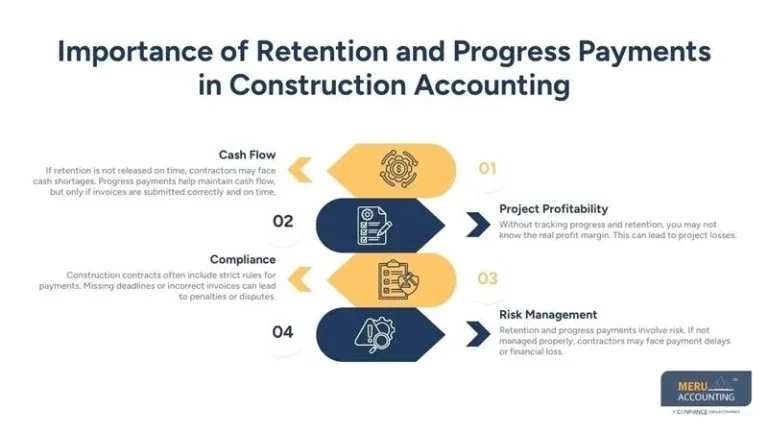
Retention and progress payments directly affect cash flow and project profitability. Without accurate tracking, contractors may not know how much money is still owed or when it will be received. Accounting for construction companies ensures payments are recorded correctly, deadlines are met, and financial data remains reliable.
Proper accounting also helps contractors follow contract terms, reduce disputes, and manage financial risk more effectively.
Best Practices for Managing Retention and Progress Payments
Strong construction accounting practices include:
- Tracking progress payments based on completed work
- Recording retention amounts separately from regular receivables
- Monitoring retention release dates
- Matching costs and revenue to each project
- Including retention in cash flow planning
These steps help contractors stay in control of their finances and avoid surprises.
How Accounting Software Helps
Construction accounting software simplifies accounting for construction companies by automating job costing, progress billing, and retention tracking. It provides real-time project reports, clear payment records, and audit-ready documentation. This reduces manual errors and saves time.
Reducing Financial Risk Through Accurate Accounting
Accurate accounting helps prevent cash flow problems, reduces payment disputes, improves profitability tracking, and ensures compliance with contract and tax requirements. With reliable financial data, contractors can make better business decisions and plan future projects with confidence.
Why Choose Meru Accounting
Meru Accounting specializes in accounting for construction companies, helping contractors manage retention, progress payments, and project-based finances accurately. Our services include job costing, retention tracking, cash flow forecasting, tax compliance, and accounting software support.
We help construction businesses stay organized, reduce financial stress, and maintain healthy project profitability.
Key Takeaways
- Retention and progress payments are common in construction projects
- Accounting for construction companies ensures these payments are tracked accurately
- Proper accounting improves cash flow, reduces disputes, and lowers financial risk
- Accounting software simplifies payment tracking and reporting
- The right accounting partner supports long-term business growth